
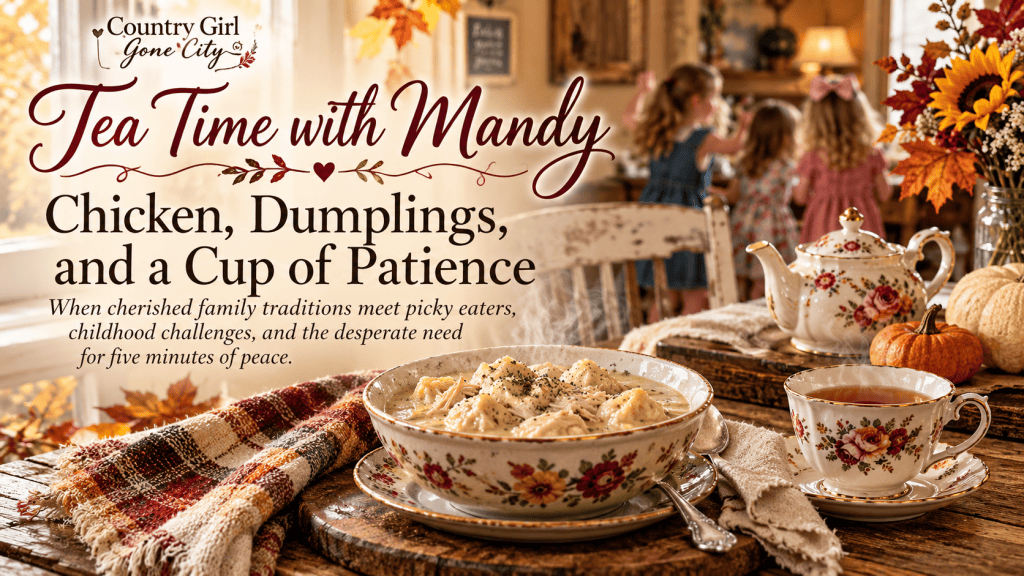
Pull up a chair, pour yourself a cup of tea, and make yourself comfortable. If you hear a little commotion in the background, don’t worry. That’s just life at my house these days. I had intended to sit down for a quiet moment with you, but apparently three little girls have other ideas about what constitutes a quiet moment. And if my tea has gone cold by the time we finish our conversation, well, it certainly won’t be the first cup I’ve reheated today.
Autumn has always been one of my favorite seasons, especially when it comes to the kitchen. Growing up with Appalachian traditions, I learned that certain foods belong to certain times of year. When the weather turns cool, there’s something wonderfully comforting about a pot simmering on the stove, the aroma of vegetables and broth filling the house, and a familiar meal bringing everyone to the table. Recipes are more than ingredients to me. They carry memories of people, places, and seasons we can never quite revisit except through the tastes and smells we remember.
This year, though, autumn has arrived with a few unexpected additions to the family table. Bringing three little girls into our home has been a blessing, but it has also been an adjustment unlike anything I’ve experienced before. I’ve raised children over the years, but caring for three little ones at once is an entirely different adventure. Some days I feel as though I’ve gone from running a household to managing a very small, very energetic committee whose members rarely agree on anything except that they all need my attention immediately.
Naturally, I wanted to share our family traditions with them. I pictured cool evenings, hearty suppers, and perhaps even the pleasure of watching them discover foods that have been favorites in our home for years. So I made a traditional vegetable beef stew. It was the kind of meal that makes the whole house smell like autumn. Our eldest little girl wouldn’t touch it.
A couple of days later, I made vegetable stew, and to my surprise she loved it—well, most of it. The peas and beans were carefully picked out, accompanied by the announcement that she was allergic to them. As far as we know, she doesn’t have a diagnosed allergy to either one; what we’ve observed is a strong aversion. Still, the distinction matters. I want her to know that she can tell me when a food bothers her without feeling that she has to call it an allergy. And, of course, any genuine reaction would need to be taken seriously.
Then came the real test: chicken and dumplings. Not just any chicken and dumplings, mind you, but one of Dexter’s all-time favorite fall staples. This is a meal that has earned its place in our seasonal traditions. I spent a good hour preparing and cooking it, imagining that comforting bowl on the table and the satisfaction of feeding my family something made with love. Our eldest wouldn’t touch it with a ten-foot pole.
Now, I would love to tell you that I smiled sweetly, accepted the situation with perfect grace, and quietly enjoyed my own supper. But that wouldn’t be an entirely truthful account of the evening. I was disappointed. I was frustrated. And yes, a little part of me felt hurt. It wasn’t only the hour of work or the ingredients. It was the sense that something I had offered with love had been dismissed without even a taste.
Sometimes we call that ingratitude. And sometimes children really do need to learn manners, consideration, and how to respond kindly when someone has worked hard for them. But I’m also learning that refusing a meal and refusing love are not the same thing.
Our eldest is undergoing developmental evaluation, and preliminary findings have raised the possibility of autism. We are still learning what that means for her. Food can be complicated for children who experience sensory differences. A familiar texture to one person may feel unbearable to another. A mixed dish, with several flavors and ingredients touching one another, can be especially difficult. Even the difference between beef stew and vegetable stew may be significant to a child, though to an adult they seem like close relatives from the same soup pot.
Understanding that doesn’t magically erase my disappointment. It does, however, remind me to look beyond the untouched bowl. Instead of turning every supper into a contest of wills, I can offer a familiar food alongside the family meal, let her explore something new without pressure, and teach gratitude through words and example rather than demanding that she eat to prove it. We can practice saying, ‘Thank you for making dinner. I’m not ready to try that today.’ That’s a lesson in kindness we can work on together.
And while we’re talking about lessons, let me tell you about another one I’m learning: apparently a mother can be loved so thoroughly that she is not permitted to drink a cup of tea in peace.

I can have the kettle on, a favorite cup waiting, and perhaps five hopeful minutes to collect my thoughts. Then one little girl needs something, another decides that her sister has committed a terrible offense involving a toy, and the third has her own urgent opinion about the matter. Before long, they’re competing for every last ounce of my attention, and my lovely private tea time has become an impromptu family conference. The tea sits there getting colder while I referee a disagreement that, five minutes later, nobody seems to remember.
I laugh about it because sometimes laughter is the only sensible response. But beneath the humor is real exhaustion. Children need affection, reassurance, and boundaries. Children who have experienced instability may need those things even more. Yet caregivers need rest, too. A few quiet minutes do not mean we love our children any less. They give us room to return to them with a little more patience and a little less weariness.
I’m discovering that I can love these girls wholeheartedly while still teaching them to wait their turn, use kind words, play without constant intervention, and respect a few moments of quiet. Those skills won’t appear overnight. They will take repetition, consistency, and more patience than I sometimes feel I possess. Some afternoons, the most ambitious goal I can manage is finishing a cup of tea while it’s still warm.
Perhaps that is why the words of Ecclesiastes 3:12–13 have been on my mind: there is goodness in rejoicing, doing good, and enjoying the fruit of our labor, because such enjoyment is a gift from God. I used to picture that enjoyment as the satisfaction of a delicious meal shared around a peaceful table. These days, I’m learning it might also be found in a little girl discovering a vegetable stew she likes, in a family adapting an old tradition to make room for someone new, or in the quiet moment that finally comes after the kitchen has been cleaned and the house has settled.
I don’t want the traditions I love to disappear. I want the girls to know where they came from and why these meals matter to our family. I want them to remember the warmth of our kitchen, the familiar smell of supper on a cool evening, and the comfort of having a place at the table. But I also want them to remember that they were welcomed there even on the days when they couldn’t eat what was served.
Maybe one day our eldest will ask for chicken and dumplings. Maybe she won’t. Dexter and I can still enjoy them, and the girls can gradually develop traditions and favorites of their own. Family life has always involved passing something down, but perhaps it also involves making room for what the next generation brings to the table.
So if you’re reading this with a reheated cup of tea beside you, a sink full of dishes, or children calling your name from another room, I hope you’ll find a little encouragement here. Your effort matters, even when nobody applauds it. Your family traditions matter, even when they need to bend a little. And your need for a moment of peace matters, too.
Now, if you’ll excuse me, I’m going to try once more to enjoy my tea. I can’t promise it will stay hot, but I can promise that somewhere in this noisy, unpredictable season there is still beauty worth noticing—and a good deal of grace to be learned.
Until next time, my friend, keep the kettle warm. With love, Mandy.
☕ Help Keep the Kettle Warm!
If you’ve enjoyed our little tea time together today, found a reason to smile, or discovered a bit of encouragement for your own journey, I’d love to invite you to Buy Me a Coffee! Between the demands of family life, the joys and challenges of caregiving, and the occasional cold cup of tea, writing has become a precious opportunity for me to share a little laughter, love, faith, and encouragement with you. Your kindness helps support the time and creativity that go into keeping Country Girl Gone City going, and every little tip is genuinely appreciated. There’s never any obligation, of course! I’m simply grateful you’ve pulled up a chair and spent a few moments with me. And who knows? Maybe with your help, I’ll finally get to enjoy a cup of tea while it’s still hot! ☕💕


Leave a Reply