
There is a question that does not get asked nearly enough.
Who commands the wind?
We tend to think of storms as natural things—patterns of weather, collisions of pressure, movements of air that follow predictable laws. And in many ways, that is true. The world we live in is structured, ordered, and governed by systems that God Himself set into motion.
But Scripture does not always speak about storms the way we do.
There is a passage that has always carried a certain weight to it:
“Wherein in time past ye walked according to the course of this world, according to the prince of the power of the air…”
— Ephesians 2:2
The air.
That same space where storms form, where winds gather, where unseen forces move with very real consequences.
So the question becomes unavoidable:
If there is spiritual authority associated with “the air”… what does that mean for the storms that move through it?
Not every storm is natural.
And not every storm is spiritual.
But Scripture is clear about one thing—storms are never meaningless.
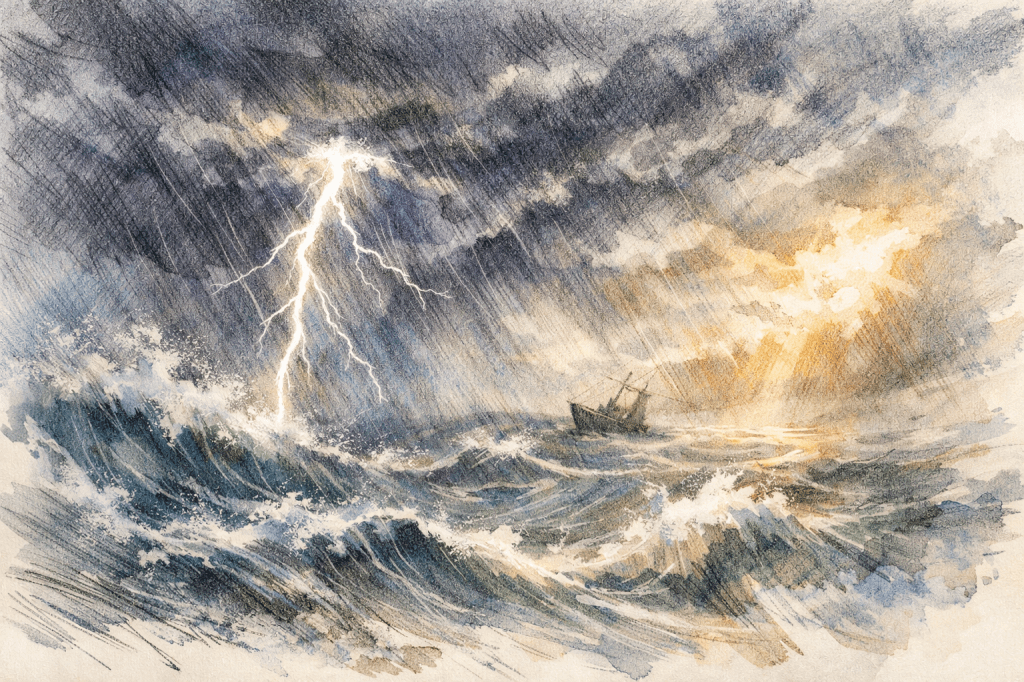
When Jesus stood in the boat and faced the raging sea, He did something remarkable.
“And he arose, and rebuked the wind, and said unto the sea, Peace, be still…”
— Mark 4:39
He did not merely observe it.
He did not simply endure it.
He did not ask the Father to calm it.
He rebuked it.
The wind responded.
The sea obeyed.
And in that moment, something was made very clear. Whatever authority exists in the storm… it is still beneath Christ.
And yet, not every storm in Scripture is handled that way.
When the Apostle Paul found himself caught in a violent tempest at sea, he did not rebuke the wind.
He endured it.
He warned others.
He held steady.
He survived.
Acts 27 tells us that the storm did not immediately cease. The ship was broken. Everything was lost.
And yet… every life was spared.
So now the question deepens.
If storms are always meant to be stopped, why was this one allowed to continue?
Because not every storm is meant to be calmed.
Some are meant to carry you somewhere you would not have gone otherwise.
Jonah learned this differently.
When he fled from what God had asked of him, a storm rose—not randomly, not accidentally, but deliberately.
A storm that exposed him.
A storm that redirected him.
A storm that forced him to confront what he was running from.
And then there is Job.
Perhaps one of the most difficult accounts in all of Scripture.
A man who suffered deeply.
A man who lost almost everything.
A man caught in a storm he did not create and could not control.
And when God finally spoke to him, He did not answer every question.
He did something else.
“Then the Lord answered Job out of the whirlwind…”
— Job 38:1
Out of the storm.
Not after it.
Not around it.
From within it.
There is something about that detail that cannot be ignored.
God does not always remove the storm. But He is never absent from it. And that is where this stops being theoretical. Because storms do not only exist in the sky. They exist in our lives.
Over the past couple of months, I have found myself standing in one storm after another, with very little space in between to understand what was happening.
I was preparing, in my heart, for the possibility of losing my husband.
Dexter’s transplant came faster than we expected. The process was intense, uncertain, and at times overwhelming. There were moments when I truly did not know how it would turn out. Moments where the future felt fragile and the weight of it all pressed in harder than I could put into words.
And then… he turned the corner.
The prayers were answered in a way I had hoped for but did not take for granted. There was relief. Gratitude. A quiet kind of joy that comes after holding your breath for too long.
But before I could fully process that moment—my father died. Not two days later. And suddenly, I found myself standing in a place I did not know how to describe.
Grief… and gratitude
Loss… and relief
Joy… and sorrow
All at once.
And just as I began trying to make sense of that mixture—something else came. A blessing. An unexpected, beautiful, overwhelming blessing that should have been easy to receive, and yet… it wasn’t simple. Because the human heart does not compartmentalize that cleanly.
Storms do not arrive one at a time.
They collide.
They overlap.
They press into each other.
They create a kind of internal atmosphere that is difficult to explain and even harder to navigate.
And if I am honest, there were moments where I felt not just emotional, but unsteady. Not just grateful, but overwhelmed. Not just grieving, but anxious in ways I did not expect.
And that is when the question came back to me again:
Who commands the wind?
Because what I was experiencing did not feel random. But it did not feel simple either.
And that is where we must be careful. Not every storm is sent. And not every storm is spiritual. But no storm is outside of God’s reach.
Some storms are the result of living in a fallen world—where bodies fail, weather shifts, and life does not always unfold gently.
Some storms are allowed (like Job’s) where God permits what He does not immediately prevent.
Some storms are corrective (like Jonah’s) where direction is being restored.
Some storms are endured (like Paul’s) where purpose is being carried forward through the breaking.
And some storms are confronted (like the one Jesus rebuked) where authority is revealed in a moment.
But in every case, one truth remains:
God is not absent.
Storms have a way of stripping away illusion. They remind us how little control we truly have.
They expose what we rely on.
They reveal what is steady—and what is not.
They humble us.
But they also do something else.
They position us.
They bring us to places we would not have gone.
They reshape what we value.
They deepen our dependence.
They remind us that strength does not come from avoiding the storm—but from standing in it with the One who commands it.
There is a reason Scripture says:
“And we know that all things work together for good to them that love God…”
— Romans 8:28
Not all things feel good.
Not all things look good.
Not all things make sense.
But all things (somehow, in ways we do not always understand) are gathered into something greater in the hands of God.
Even storms.
Especially storms.
Because while storms often bring destruction… they also clear, reshape, and make room for what could not exist before.
That does not make them easy.
But it does make them purposeful.
And perhaps that is the hardest truth to sit with:
God does not waste what we endure.
There is a difference between watching a storm and standing in one.
And when you are standing in it—when the winds are loud, when the ground feels uncertain, when everything in you is trying to hold steady—you begin to understand something you could never learn from a distance.
You begin to understand who God is.
Not just in peace.
But in power.
Not just in stillness.
But in the storm.
Closing Reflection
If you are in a storm right now—whether it feels natural, spiritual, emotional, or something you cannot fully define—you are not standing in it alone.
You may not understand it.
You may not like it.
You may not see the purpose yet.
But it is not outside of God’s reach.
And no matter what kind of storm it is…
He is still the One who commands the wind.
Closing Prayer
Lord,
For those who find themselves in the middle of a storm they cannot control, I ask that You would make Your presence known in a way that steadies them.
For those who are overwhelmed by what they are carrying, remind them that You are not absent from their circumstances.
For those who are questioning, searching, or trying to understand what You are doing, give them peace even before understanding comes.
And for those who have seen both loss and blessing collide in ways they were not prepared for, hold them steady in the tension.
You are not only the God of calm waters.
You are the God of the storm.
And we trust You, even here.
In Jesus’ name,
Amen.
Support This Work
If this message met you in a place you didn’t quite have words for…
You’re not alone.
This space was created for moments like this — for those learning how to feel again, to rest again, and to find peace in the middle of the storm.
If you would like to help keep this space going, you can support the work here:

Your support allows me to continue writing, sharing, and reaching others who may be carrying more than they can say out loud.


Leave a Reply