
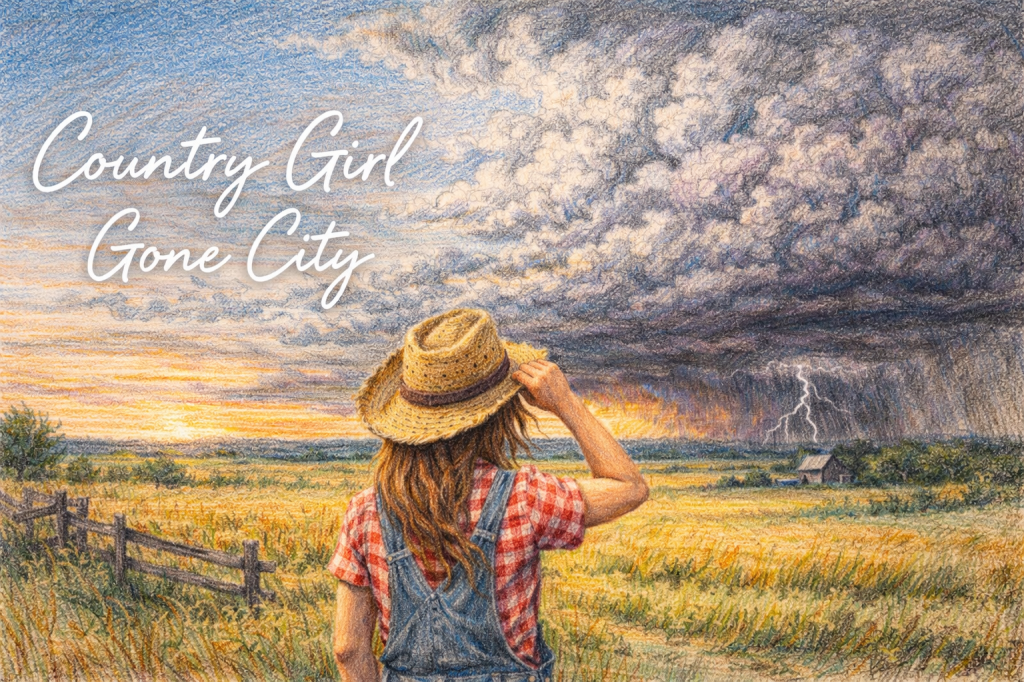
There is a question I have found myself returning to more than once in my life, and it is not as simple as it first sounds.
Why are we drawn to what can destroy us?
It is a strange thing to admit, but I have always been fascinated by storms, and particularly tornadoes. Not in a careless or reckless way, and certainly not without respect for the damage they leave behind, but in a way that is difficult to fully explain. There is something about their power, their unpredictability, the way they seem to form out of nothing and yet carry the force to alter everything in their path.
They are terrifying.
And yet… people watch them.
People track them, study them, film them, stand at a distance just close enough to witness their formation, their movement, their intensity. We warn against them, we prepare for them, we fear them, and still, there is something in us that wants to see them.
That contradiction has always intrigued me.
Because it is not just about weather.
It is about us.
There is something in human nature that is drawn to intensity. Something that leans toward what is powerful, what is unpredictable, what carries both beauty and danger at the same time. We say we want peace, and in many ways we do, but there is another part of us that recognizes something in the storm—something that feels almost alive in a way that quiet does not always immediately offer.
Perhaps that is why storms are so captivating.
They demand attention.
They do not ask permission.
They remind us, very quickly, that we are not in control.
And maybe that is part of it—the tension between control and surrender. There is a difference between standing safely at a distance and watching a storm unfold, and being caught inside of it. From far away, there is awe. There is curiosity. There is even a strange kind of beauty in the movement, in the structure, in the sheer force of it.
But inside the storm, there is no fascination.
Only survival.
That difference matters more than we realize.
Because if we are honest, storms do not only exist in the sky. They exist in our lives, in our emotions, in our relationships, in our circumstances. And just like the ones that form over open land, they often begin subtly. A little shift in pressure, a change in atmosphere, something small that builds until it is no longer small at all.
And here is the part that is harder to admit:
Sometimes we are not just caught in storms.
Sometimes we are drawn to them.
Not always intentionally.
Not always knowingly.
But there is a pull.
A pull toward intensity.
A pull toward what feels powerful.
A pull toward what disrupts the ordinary.
For some, it may be the familiarity of chaos, a life that has known stress, pressure, unpredictability, and high emotion for so long that stillness begins to feel foreign. For others, it may be curiosity, or a desire to understand what they fear, or even a need to stand close enough to something overwhelming just to prove that they can.
And sometimes, it is something deeper still.
Sometimes the storms we are drawn to reflect something already stirring inside of us.
There is a difference between watching a storm and feeling one.
And I think that is where the lesson begins.
Because fascination can be misleading. It can make something dangerous feel distant, something powerful feel manageable, something destructive feel almost… beautiful. But proximity changes everything. What looks captivating from a distance can become consuming up close.
Not everything that draws us is meant to be touched.
Not everything that holds power is meant to be approached.
And not every storm is meant to be studied from the inside.
There is wisdom in recognizing the difference.
There is wisdom in knowing when to step back, when to take shelter, when to respect what we do not control. There is wisdom in understanding that just because something awakens our attention does not mean it is safe for our lives.
Storms have a way of revealing truth.
They strip away illusion.
They expose weakness.
They remind us of limits we would rather forget.
But they also teach.
They teach us about structure and instability, about pressure and release, about how quickly conditions can change, and how necessary it is to be grounded before they do.
And perhaps most importantly, they teach us that there is a difference between observation and experience.
Between watching and surviving.
Between standing at a distance and standing in the path.
That is not just a lesson about weather.
It is a lesson about life.
Because there will always be storms that pass through this world, and there will always be something in us that is drawn to their power. But understanding that pull (questioning it, respecting it, and knowing when to step away from it) may be one of the most important things we learn.
There is a difference between watching a storm… and standing in one.
And until you have stood in it, you do not fully understand what it takes to survive it.
“God’s voice thunders in marvelous ways; he does great things beyond our understanding. He says to the snow, ‘Fall on the earth,’ and to the rain shower, ‘Be a mighty downpour.’”
Job 37:5-6 NIV
Closing Reflection
If you have ever found yourself drawn to something you knew carried risk (something powerful, intense, or unpredictable) you are not alone.
But not everything that captures your attention is meant to have access to your life.
Some things are meant to be respected from a distance.
And some storms… are meant to be survived, not studied.
Support This Work
If this piece made you pause, reflect, or see something in a new way, you can support my writing through Buy Me a Coffee. Your support allows me to continue creating thoughtful, faith-centered content that speaks to both the quiet and the difficult places in life. ♥️



Leave a Reply