
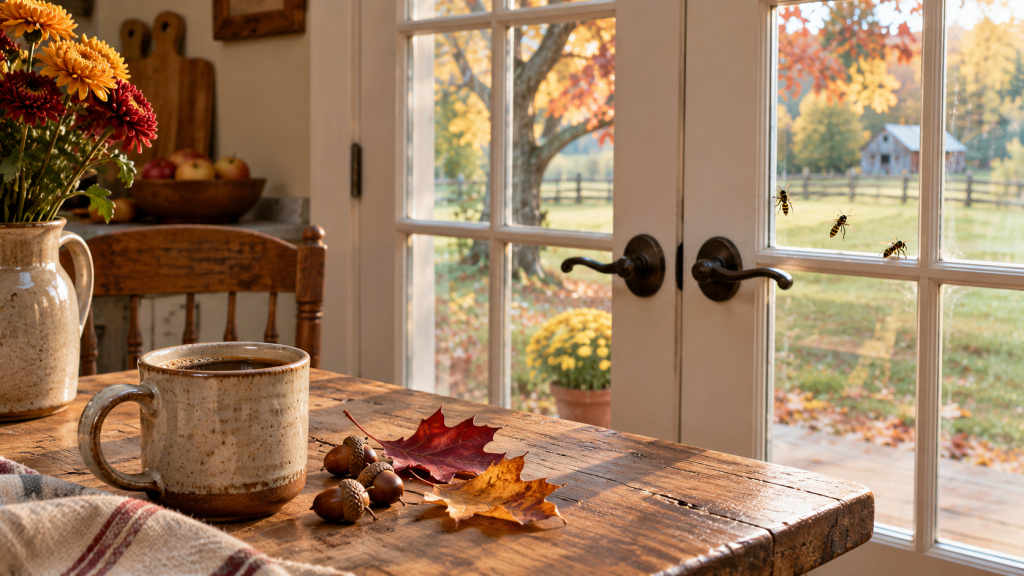
Three little girls, a swarm of yellow jackets, and the unexpected lessons waiting just outside our back door.
“In the beginning was the Word, and the Word was with God, and the Word was God. He was in the beginning with God. All things were made through Him, and without Him nothing was made that was made.”
John 1:1-3 NKJV
There are mornings when the country greets you with birdsong, a gentle breeze, and the promise of a peaceful day. And then there are mornings when you discover that an entire congregation of yellow jackets has apparently decided to hold its Sunday service on your back French doors.
This morning, unfortunately, was the latter.
The children were already running through the house, their laughter and little footsteps echoing from room to room. Dexter had left early for appointments in Atlanta, and I was settling into my usual morning routine of preparing the baby’s bottle and making my coffee. Everything seemed perfectly ordinary until I happened to glance toward the glass French doors at the back of the house.
Well, mercy!
There they were. Yellow jackets. And not just one or two, mind you. There were enough of them to make this country girl reconsider her morning plans!
Now, having grown up in the country, I know a thing or two about yellow jackets, and one of those things is that they are certainly not creatures you want to aggravate. Unlike the gentle bumblebee, which generally prefers to mind its own business while visiting the flowers, yellow jackets can become particularly defensive when their nests are threatened. And when they decide to defend themselves, they may bring along a few dozen of their closest relatives!
So, rather than make a fuss, I quietly backed away from the doors and instructed the children to calmly walk to their bedrooms.
No screaming. No running about. No frantic waving of arms.
And, much to my delight, those three little girls listened beautifully!
Once everyone was safely away from the area, I contacted Dexter, who gave me the number for our exterminator. While we waited for help to arrive, I found myself doing what mothers and grandmothers have done for generations: turning an unexpected situation into an opportunity to teach.
We talked about bees, wasps, and yellow jackets, and why it is important to respect them. I explained that when we encounter bees or other stinging insects, we shouldn’t swat at them or deliberately disturb them. We should remain calm and move away carefully, without making sudden movements. Of course, if a nest is disturbed and yellow jackets begin attacking, getting quickly into an enclosed shelter is the safest response.
I explained that although many insects may look frightening, most are simply going about the business God created them to do. Some pollinate our flowers, others help keep the population of harmful insects under control, and still others play important roles in maintaining the delicate balance of the natural world.
And then there are yellow jackets, which apparently occasionally like to remind us who’s boss!
Thankfully, our exterminator arrived, the situation was handled, and I am happy to report that nobody was hurt.
But as I watched the girls throughout the morning, I found myself thinking about something far more meaningful than our unexpected visitors.
A Classroom Without Walls
Over the past several weeks, I’ve been amazed by how much these little girls are learning simply by spending time here at our country house.
There is something wonderfully refreshing about watching children discover the natural world with the kind of curiosity that only childhood can produce.
A tiny lizard becomes a fascinating new friend. An acorn becomes a treasure worth examining. Fallen leaves become opportunities to discover shapes, colors, and the differences between trees. Even spiders, which many grown adults would rather avoid entirely, have become subjects of our little nature lessons.
We’ve talked about which spiders are generally harmless and which ones should be admired from a safe distance. We’ve watched lizards dart across the porch and learned that even the smallest creatures deserve to be treated gently. We’ve examined plants and explored the difference between those that are useful and those that can be dangerous.
And oh, the questions!
Sometimes I believe children must come equipped with an endless supply of them. Just when you think you’ve answered the last one, another comes tumbling out!
But I wouldn’t trade those questions for anything.
Because behind every little “Why?” is a growing mind trying to understand the world.

A Little Country Wisdom Goes a Long Way
One of my favorite things about raising children in the country is passing along the practical knowledge that generations before us learned through everyday experience.
There was a time when knowing how to recognize useful plants, identify dangerous creatures, predict changing weather, and navigate the woods wasn’t considered an extracurricular activity. It was simply part of life.
You learned by watching your parents and grandparents, by helping in the garden, by walking through the woods, and sometimes by making a few mistakes along the way.
Recently, I’ve been introducing the girls to plants such as rosemary and dog fennel, both of which have histories of use as natural insect deterrents.
Now, anyone who has spent a Georgia summer outdoors knows that mosquitoes seem to believe every family gathering is an open invitation to dinner. And wouldn’t you know it, we’re the main course!
So you can imagine the expressions on those little faces when I explained that certain plants contain aromatic compounds that can help discourage insects.
The girls were fascinated!
Dog fennel, in particular, has a strong fragrance when its feathery leaves are crushed. It has long been associated with traditional insect-repellent practices, and research has explored the repellent properties of its essential oils. Of course, knowing the usefulness of a plant also means understanding its limitations and dangers. Dog fennel is not culinary fennel, should never be eaten, and shouldn’t be treated as a proven substitute for skin-safe insect repellents.
That, too, is part of country wisdom: learning not only what nature can provide but also how to approach it responsibly.
It is rather delightful to see the wonder in a child’s eyes when she realizes that something growing wild along a country path might have a purpose beyond simply being another weed.
And I suppose that’s one of the things I love most about these little lessons. They teach children to look a little closer at the world around them.
Teaching Courage Without Teaching Fear
Perhaps the greatest lesson of today’s yellow jacket adventure had very little to do with insects at all.
It was a lesson in courage.
You see, courage doesn’t always look like someone charging into danger with tremendous bravery. Sometimes courage is simply having the presence of mind to remain calm when something unexpected happens.
Sometimes it means listening carefully, following instructions, and understanding that the wisest thing you can do is walk away.
As I watched those little girls quietly make their way to safety this morning, I realized how much they are already learning.
Children aren’t born knowing how to recognize every danger. They depend upon us to teach them. And while it may be tempting to protect them from every uncomfortable or frightening experience, we do them a far greater service when we equip them with the knowledge and confidence to handle the unexpected.
That doesn’t mean exposing them unnecessarily to danger. It means teaching them to recognize it, respect it, and respond appropriately.
There is a tremendous difference between being afraid of the world and understanding how to live safely within it.
I want these girls to grow up knowing that the woods aren’t something to fear, but neither are they a place to wander carelessly. That insects aren’t all enemies, but some deserve a respectful distance. That plants can be beautiful and useful, but some can also be harmful.
Most importantly, I want them to understand that knowledge gives us confidence, and wisdom teaches us how to use it.
The Lessons We Never Planned to Teach
As parents, we spend so much time thinking about the things our children need to learn. We worry about letters and numbers, reading and writing, proper manners, and whether they’re developing the skills they’ll need for adulthood.
All of those things are important, certainly.
But I wonder if sometimes we overlook the extraordinary value of the ordinary moments.
The unexpected visitor on the porch. The tiny lizard hiding beneath a flowerpot. The interesting leaf discovered along a walking path. The questions that begin with “Mommy, what’s that?” and somehow lead to a conversation about God’s wonderfully intricate creation.
These moments may never appear on a school report card, but they have a way of shaping the people our children become.
And perhaps that’s why I’ve been enjoying this season of our lives so much.
These three little girls have brought a tremendous amount of laughter, excitement, and, yes, occasional chaos into our home. But they’ve also reminded me of the wonder of seeing the world through a child’s eyes.
Things I might ordinarily pass without a second thought have suddenly become fascinating again.
An acorn isn’t merely an acorn. It’s the beginning of a mighty oak.
A caterpillar isn’t simply something crawling across the sidewalk. It’s a little creature with an extraordinary transformation ahead of it.
And a morning interrupted by yellow jackets?
Well, apparently that’s an opportunity for a lesson in courage, obedience, and a little good old-fashioned country sense!
The Wisdom We Leave Behind
Scripture tells us in Proverbs 22:6 to train up a child in the way he should go, reminding us of the lasting influence of the lessons we impart during childhood.
I’ve been thinking about that quite a bit lately.
There is something profoundly meaningful about knowing that the little things we teach our children today may someday become the wisdom they pass along to their own children.
Perhaps one day, many years from now, one of these girls will find herself standing in her kitchen, preparing breakfast while her own children play nearby. She might glance toward a window and discover a few unwelcome buzzing visitors.
And perhaps, without even thinking about it, she’ll remember a morning long ago at our country house, when Mommy calmly gathered everyone to safety and explained what to do.
Maybe she’ll remember the lizards, the acorns, and those wonderfully fragrant plants growing along the edge of the yard.
Maybe she’ll remember that the world is full of marvelous things worth discovering, and that a little knowledge can go a long way toward keeping us safe.
Or perhaps she’ll simply smile and say, “Well, mercy! I remember when…”
And if that happens, I will consider every question, every muddy shoe, every rescued lizard, and even today’s unexpected yellow jacket invasion time very well spent.
Because the greatest lessons we leave our children aren’t always the ones we sit down intending to teach.
Sometimes they’re the ones life gives us when we’re simply trying to make our morning coffee.
And that’s just one more of life’s little lessons.
With love and a little country wisdom,
Amanda
Country Girl Gone City
If this little country adventure brought a smile to your face or reminded you of lessons passed down in your own family, I’d be grateful if you’d consider leaving a tip on Buy Me a Coffee. Your kindness helps support Country Girl Gone City and the stories, encouragement, and everyday wisdom I share here. Thank you for pulling up a chair and being part of this journey with me!



Leave a Reply