
Caregivers Cozy Corner Series Pt 2
There’s a particular kind of tiredness that settles in when caregiving is not one-sided—when there isn’t a “healthy one” to lean on, no clear division of strength and weakness, no easy roles to assign.
This corner is for those moments.
If you’re reading this while holding a warm cup of something, sitting quietly for a few minutes before the next responsibility calls your name, know this: you are seen here.
When There Is No Backup
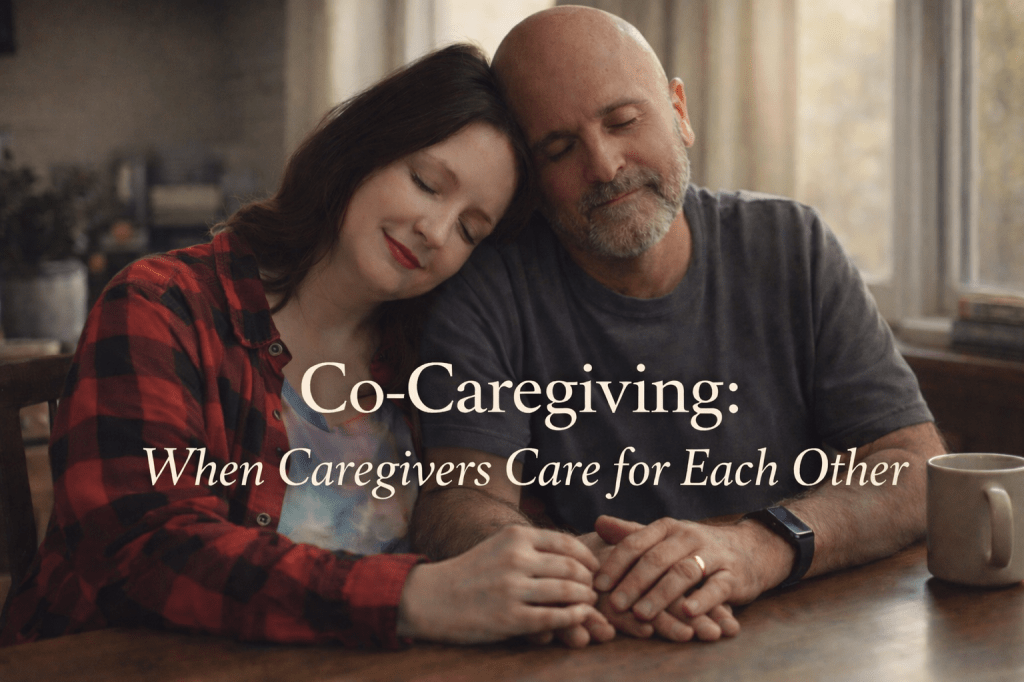
For much of my married life, caregiving has not flowed in one direction. My husband and I have always cared for one another. Sometimes simultaneously, other times quietly, but often without help from others.
In our younger years, it looked like both of us coming down with the flu at the same time. No one stepping in. No one bringing us a bowl of soup. No, we were just simply two tired people taking turns resting, taking turns getting up and taking turns doing only what absolutely had to be done.
Now, as the years have passed, co-caregiving has deepened. We’ve learned to navigate rare diseases and syndromes together while learning each other’s limits, recognizing when one of us needs rest before the words are even spoken. Love has become more attentive. Care has become more gentle. But the absence of help can still ache.
The Loneliness No One Talks About
There is a quiet loneliness that comes with co-caregiving. It’s not always about needing someone to do something, but rather it’s often about longing for understanding, for friendship, for compassion from family who may not know how to enter this space.
Scripture never denies the reality of this kind of loneliness. Even Jesus, surrounded by disciples, withdrew to lonely places to pray (Luke 5:16). In Gethsemane, He asked His closest friends to stay awake with Him—and they could not (Matthew 26:40).
Loneliness does not mean a lack of faith. And longing does not mean ingratitude. Sometimes, it simply means you are human.
Bearing One Another—Together
The Bible speaks tenderly to shared burdens:
“Bear ye one another’s burdens, and so fulfil the law of Christ.” (Galatians 6:2)
This verse is often quoted in community contexts, but it also applies deeply within marriage. Sometimes bearing one another’s burdens looks like strength. Other times it looks like shared weakness, and still choosing love.
Ecclesiastes reminds us:
“Two are better than one… For if they fall, the one will lift up his fellow.” (Ecclesiastes 4:9–10)
But what happens when both have fallen?It may make lifting look smaller, quieter, or even slower.
It may look like grace instead of productivity, or presence instead of answers.
What I’ve Learned Along the Way
After 25 years of marriage, I’ve learned that co-caregiving is not about perfection. It’s about attentiveness. About humility. About letting go of expectations that were never promised.
I’ve learned that God does not require us to carry each other without rest. He does not measure love by exhaustion. Even Elijah, after a great spiritual victory, collapsed in weariness and God’s response was not correction, but food and sleep (1 Kings 19:5–8).
Sometimes the most faithful thing we can do for one another is to rest when rest is offered.
If This Is Your Story Too
If you are caring for someone who is also caring for you—if there is no safety net beneath your feet and if the loneliness feels sharper because the love is real. Please hear this:
1. You are not failing.
2. You are not unseen by God.
And you are not wrong for longing for more support.
God is near to the weary, not just the strong. He gives wisdom generously to those who ask (James 1:5), and He does not despise weakness but rather He meets it with compassion, where we are.
If this is you, pull your chair a little closer to this corner. Stay awhile. You are not alone here.
☕ A Gentle Invitation
If Caregivers Cozy Corner has offered you comfort, encouragement, or simply the feeling of being understood, you can support this work by leaving a tip at Buy Me a Coffee. Your support helps make space for more quiet corners like this. Places where tired hearts can rest for a moment.
Thank you for being here.
 Country Girl Gone City
Leave a comment