
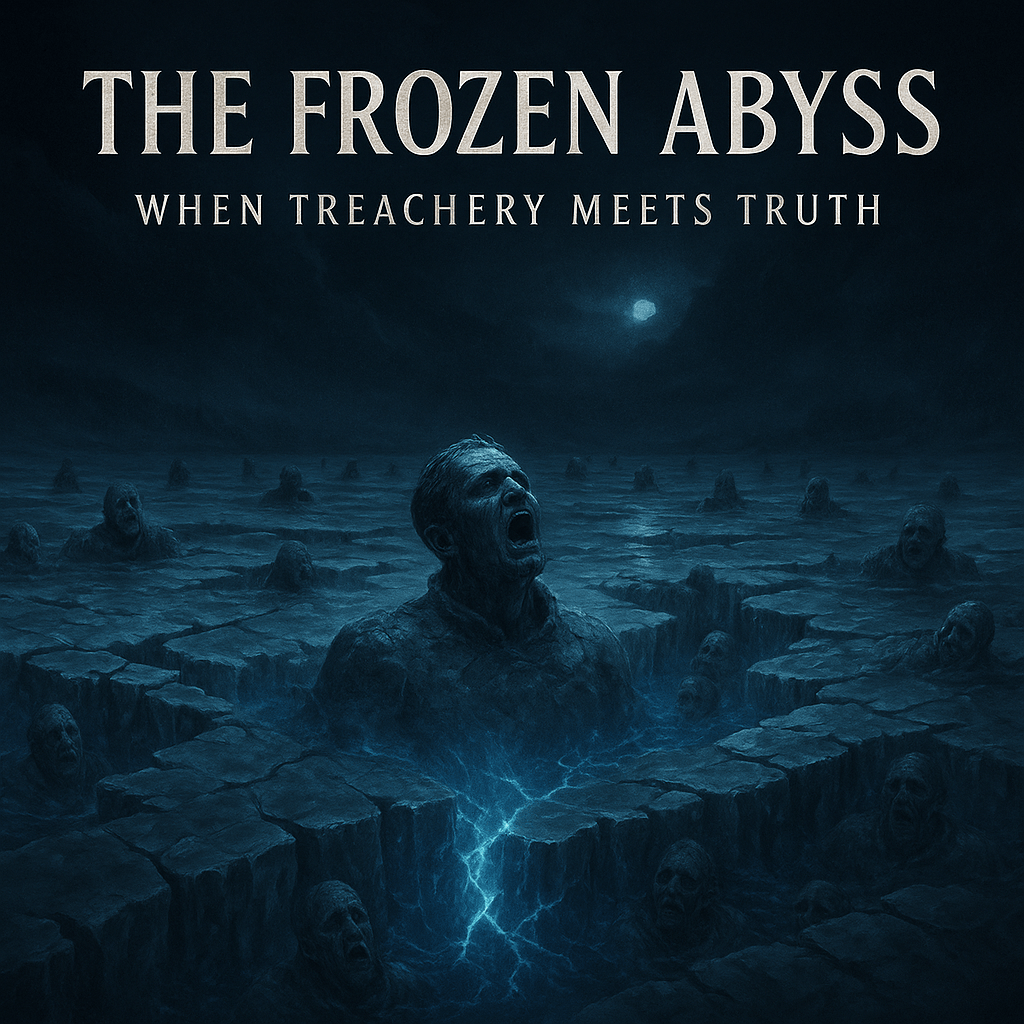
As we near the end of Dante’s Inferno, we arrive at the most chilling and terrifying place of all—the Ninth Circle of Hell, reserved for the treacherous. It is here, in the frozen lake of Cocytus, that Dante comes face to face with the very image of despair: Satan, bound and frozen in ice, flapping his massive wings in a futile attempt to escape, creating the bitter winds that imprison the accursed souls around him.
This frozen abyss is divided into four regions—each one darker than the last. Caina for those who betrayed family, Antenora for those who betrayed their country, Ptolomea for those who betrayed their guests, and Judecca—the lowest pit—for those who betrayed their masters and benefactors. It is there, in the center of eternal frost, that Dante places Judas, Brutus, and Cassius—the ultimate betrayers—forever chewed in the mouths of Satan.
The Meaning of the Ice
Unlike the fiery torments of earlier circles, this final realm is cold—frozen, still, and utterly lifeless. It is the perfect image of what sin ultimately becomes: not passion, not fury, but apathy. The fire of rebellion has burned out, leaving only the icy separation from God’s warmth.
Jesus said in Matthew 24:12, “Because of the increase of wickedness, the love of many will grow cold.”
This is the Ninth Circle—where love itself has died.
In this place, we see the ultimate result of sin and betrayal: spiritual paralysis. Those who lived without mercy, who betrayed trust and love, are now unable to move or feel. They are frozen in the state of their own rebellion.
Tartarus: The Biblical Parallel
While Dante’s vision is poetic, it reflects a biblical truth. Scripture describes a place called Tartarus in 2 Peter 2:4:
“For if God did not spare angels when they sinned, but cast them into hell and committed them to chains of gloomy darkness to be kept until the judgment…”
This passage refers to the fallen angels—those who turned against God and are now bound in darkness until the final day of judgment. These beings, once radiant, are now confined in a cold prison of separation, much like Dante’s frozen traitors.
And just as those angels are chained in Tartarus, many souls today walk bound by the same invisible chains—chains of pride, deceit, betrayal, and self-worship. These are not mythic punishments; they are spiritual realities. Sin doesn’t just lead to separation from God in eternity—it begins to separate us from Him even now.
A Personal Reflection
When my husband Dexter nearly died in 2018, he saw things that would forever change us both. His near-death experience revealed visions of Hell—scenes that mirrored Dante’s descriptions far more closely than we could have ever imagined. He saw the violent boiling in blood, the deceivers consumed in flame, and finally, the frozen pit where the light of God could not reach.
It shook us to our core.
We had believed we were safe—we had professed Christ, preached His Word, and lived what we thought was a righteous life. But deep within, we were still clinging to fear, pride, and self-reliance. We had allowed small compromises to harden our hearts, just as the ice hardens the Ninth Circle.
God used that moment to break us—to strip away every illusion of control and bring us to a place of full surrender.
As 1 John 4:18 reminds us, “Perfect love casts out fear.”
But we cannot walk in perfect love when we are still chained to self.
The Cold Truth of Betrayal
The Ninth Circle teaches us that the greatest sin is not rage against God, but betrayal of His love. It’s when we claim His name yet live in hypocrisy. It’s when we profess Christ but choose the world.
Jesus said in Matthew 7:21-23:
“Not everyone who says to Me, ‘Lord, Lord,’ will enter the kingdom of heaven, but only the one who does the will of My Father… I will tell them plainly, ‘I never knew you. Depart from Me, you workers of lawlessness.’”
Hell is not merely a place of punishment—it is a mirror of our choices. Every decision to deceive, to betray, to turn away from love, freezes the soul a little more until, like those in Dante’s Cocytus, we find ourselves unable to move, unable to feel, unable to change.
From Ice to Fire: A Call to Life
But this isn’t the end of the story. Because where Dante’s journey ends in ice, Christ’s story ends in fire—holy fire. The consuming, refining fire of the Holy Spirit burns away everything that keeps us bound.
Revelation 21:4 promises:
“He will wipe every tear from their eyes, and there will be no more death or mourning or crying or pain.”
You see, where Satan’s wind freezes, God’s breath gives life.
Dexter and I learned that salvation is not just a confession—it’s a continual surrender. Every day, we must choose to melt the ice by drawing near to the warmth of Christ. Every moment we spend in His presence thaws another layer of the heart.
A Call to Consider Your Ways
Friend, I say this with all the love and urgency in my heart: Hell is real. It’s not just for the blatantly wicked—it’s for the proud, the unrepentant, the self-deceived. It’s for those who have grown cold toward God.
But there is still time. 2 Corinthians 6:2 says, “Now is the day of salvation.”
Don’t wait until it’s too late. Come back to the One who can break the ice, who can breathe warmth into your spirit again.
He’s waiting for you.
Final Thought
As we close this series, I urge you—choose life over death, truth over deception, surrender over pride.
The frozen lake may be terrifying, but the fire of God’s love is stronger still. Let Him melt your heart before the world finishes hardening it.
As Joshua 24:15 declares,
“Choose this day whom you will serve.”
Let it be the Lord who offers life, not death.
💛 Support the Mission
If this message stirred something in your heart or reminded you of the hope found in Christ, I invite you to support my writing ministry. Every Buy Me a Coffee contribution helps me continue creating faith-centered content that reaches souls across the world with truth, hope, and the gospel.
Together, we’re spreading light in dark places—one story, one heart at a time.

 Country Girl Gone City
Leave a comment