
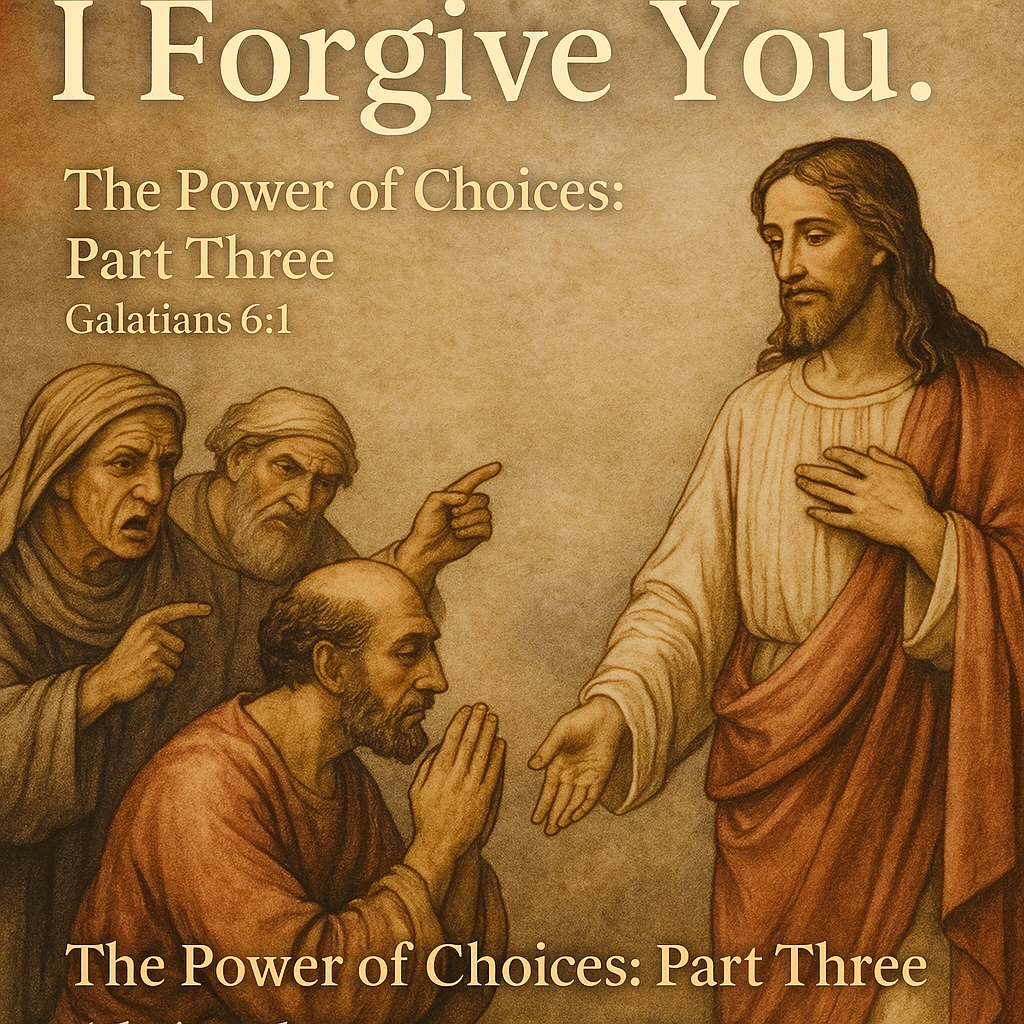
“I Forgive You.”
Three simple words. Yet when spoken from the heart, they carry a divine weight far heavier than the stones others are eager to cast.
Recently, I found myself in a deeply unsettling storm within the Christian Contemporary Music world. A well-known artist—whose name I will not mention out of respect for all involved—was exposed for making devastatingly poor choices. Choices that not only harmed the victims directly involved but sent shockwaves across ministries, families, and the broader faith community. I had followed this artist’s career for nearly 30 years. I had worshipped to his music. And now, I watched as scandal unfolded and many voices turned from praise to condemnation.
But I chose something different. I commented publicly with three words: “I forgive you.”
The backlash was immediate. People lashed out—not at the artist this time—but at those of us who extended grace. “How dare you forgive him?” they shouted. “You weren’t the one he hurt!”
But I wasn’t speaking on behalf of victims. I was speaking on behalf of Christ.
“Be kind and compassionate to one another, forgiving each other, just as in Christ God forgave you.”
(Ephesians 4:32, NIV)
You see, forgiveness isn’t about dismissing wrongdoing. It’s not about cheap grace or ignoring justice. It’s about reflecting the heart of our Savior, who forgave us while we were yet sinners (Romans 5:8). Forgiveness is a choice—and it’s one of the most powerful, Christlike choices we can ever make.

The ripple effects of sin are real. Just like King Saul’s refusal to fully obey God in 1 Samuel 15 when he spared King Agag of the Amalekites—against God’s clear command—set into motion a generational curse. That one disobedient decision echoed hundreds of years later in the Book of Esther when Haman the Agagite plotted to annihilate the Jews. Saul’s single bad choice became a national crisis, and it took the bravery of Queen Esther, who chose to risk her life, saying, “If I perish, I perish,” (Esther 4:16) to stop it.
Bad choices can destroy lives. But godly choices, even in the face of great opposition, can save them.
In a generation drowning in moral confusion—where truth is considered “relative,” and wrong is often praised as “bold authenticity”—we must remember that God has never stopped giving people free will. And with that will comes responsibility. It is not God’s fault when people choose evil. God is not a manipulator. He is a Father who lets us choose, because only in freedom can love be real.
“I have set before you life and death, blessing and curse. Therefore choose life, that you and your offspring may live.”
(Deuteronomy 30:19, ESV)
Even when we choose wrongly, His grace is there. But grace does not cancel consequences—it walks us through them. And for those of us watching the fallout of public failures in the Church, we are still responsible for our own choices: to judge or to restore, to condemn or to intercede.
As leaders, believers, and image-bearers of Christ, our duty is clear: “If someone is caught in a sin, you who live by the Spirit should restore that person gently. But watch yourselves, or you also may be tempted.”
(Galatians 6:1, NIV)
In summary, our choices—public or private, small or significant—shape not just our lives, but the legacy we leave. We are not powerless. We always have a choice. Whether to forgive or to hold a grudge. Whether to obey or rebel. Whether to build up or tear down. My prayer is that we choose life, choose love, and choose to reflect Christ… especially when it’s hard.
If this message encouraged you or made you think differently about the power of your own choices, I invite you to support my writing through a tip on Buy Me A Coffee. Your support fuels more truth-filled content, advocacy, and encouragement for believers walking through hard choices every day.
Thank you for being part of this journey. 💛

 Country Girl Gone City
Leave a comment